Safety is the foundation of any serious industrial operation. You can have the best equipment, the most sophisticated machinery, and the most carefully managed processes. But if electricity isn’t properly grounded, everything becomes dangerous.
That’s what earthing material does. It protects people, equipment, and facilities from electrical hazards. And in a growing industrial hub like Greater Noida, getting this right isn’t optional.
Whether you’re building a new facility, upgrading existing infrastructure, or maintaining current systems, you need reliable earthing material manufacturers who understand both the technical requirements and the local industrial environment.
What Earthing Actually Does
Many people use the words “earthing” and “grounding” interchangeably. In practice, they mean the same thing. It’s about creating a safe path for electrical current to flow into the ground, away from people and equipment.
Here’s why this matters:
Every electrical system generates faults. Insulation fails. Equipment malfunctions. Weather strikes facilities. When these things happen, electrical current needs somewhere to go. Without proper earthing, that current finds the path of least resistance, which often means through people or critical equipment. Results are catastrophic—fires, explosions, electrocution, equipment damage.
Proper earthing provides an intentional, safe path for this dangerous current to dissipate into the earth. It’s elegant in its simplicity but absolutely critical in execution.
Greater Noida’s industrial landscape includes power generation facilities, manufacturing plants, data centers, hospitals, and commercial complexes. Each one handles significant electrical loads. Each one needs proper grounding systems to operate safely.
This is why earthing material manufacturers in Greater Noida are essential infrastructure partners for the region.
Types of Earthing Materials: Understanding Your Options
Earthing systems aren’t one-size-fits-all. Different applications need different materials. Here’s what’s available:
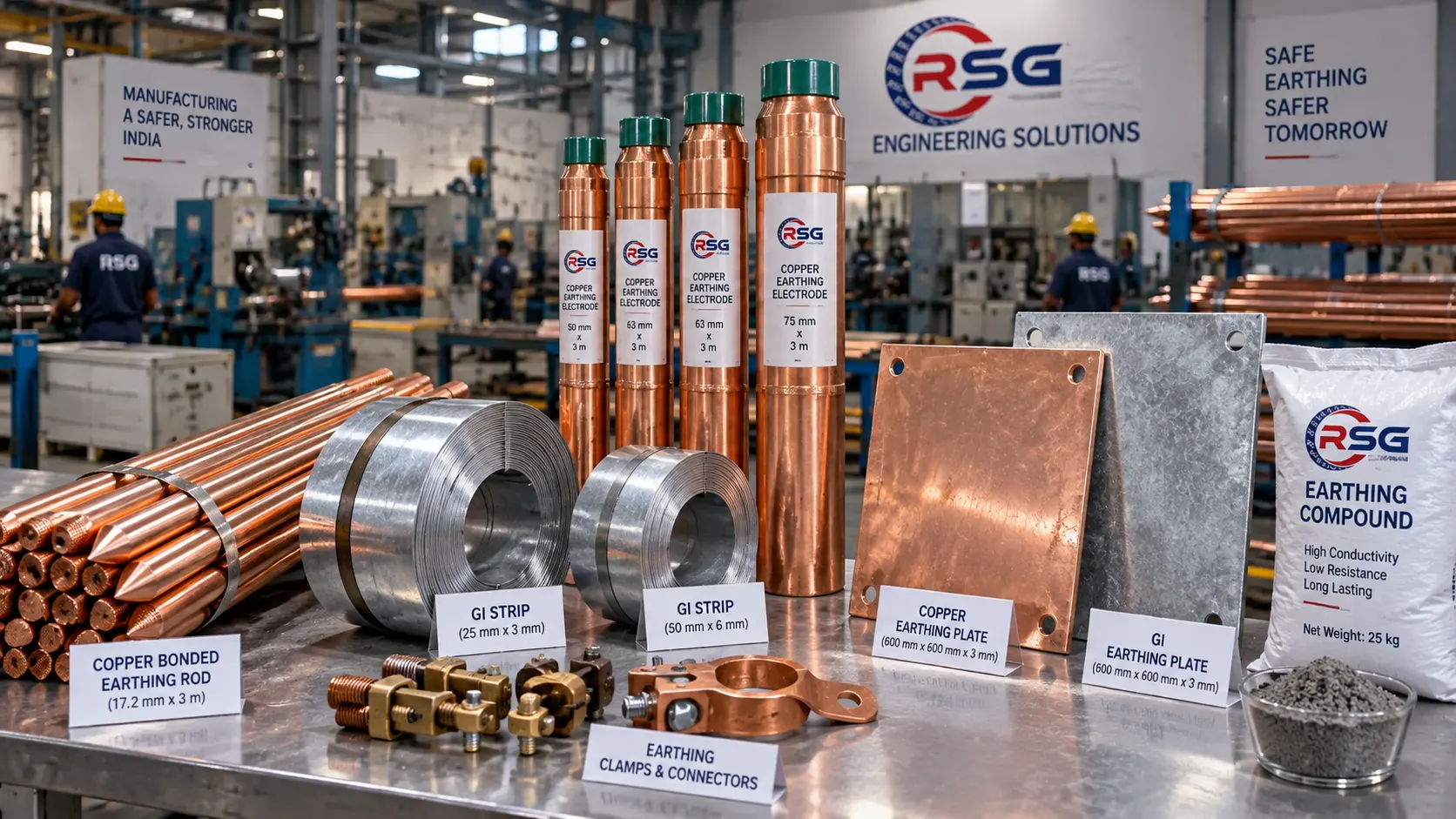
Copper Bonded Rods
These are the workhorses of grounding systems. They’re steel rods with a layer of copper bonded to the surface through a molecular process. The steel provides structural strength, while the copper provides excellent electrical conductivity.
Copper bonded rods are driven into the ground to create direct connection with soil. The typical diameter is 16mm, and they’re often driven to depths of 2-3 meters or more, depending on soil conditions and required resistance.
Why copper bonded instead of solid copper? Cost and practicality. Solid copper rods would be prohibitively expensive and difficult to drive into hard soil. Copper bonded rods give you the electrical performance of copper at a fraction of the cost, with structural strength for installation.
In industrial facilities around Greater Noida, copper bonded rods are standard. They’ve been tested in the region’s soil conditions and proven reliable.
GI Strips and Conductors
GI (Galvanized Iron) strips connect earthing rods to equipment and buildings. They carry the current from where it’s generated safely to the earthing point.
These aren’t random metal strips. They’re standardized by Indian Standards. They need to have sufficient cross-sectional area to carry expected fault current without overheating. They need to be properly sized based on the amperage they’ll handle.
GI strips are typically 25mm to 50mm wide and vary in thickness based on current-carrying requirements. They’re installed using proper fastening to prevent loosening over time.
Copper Electrodes
For applications requiring extremely low resistance, copper electrodes are used. These are pure copper rods or plates that provide exceptional electrical conductivity.
Copper electrodes are more expensive than copper bonded rods but sometimes necessary in applications like data centers, hospitals, or facilities handling sensitive electronics where even slight voltage variations can cause problems.
Earthing Plates
These are metal plates (typically 600mm x 600mm or larger) buried in the ground as part of the grounding system. They work with rods to increase the surface area in contact with soil, reducing overall resistance.
Earthing plates are particularly useful in areas with high soil resistivity or where space constraints prevent driving deep rods.
Chemical Earthing Components
In difficult soil conditions (dry, rocky, or sandy soil with high resistivity), standard earthing sometimes doesn’t achieve required low resistance. Chemical earthing systems use specialized salts and compounds mixed with backfill around earthing rods to reduce soil resistivity.
This improves current flow and reduces overall earthing resistance. The compounds work by hygroscopic action, meaning they absorb and retain moisture, which improves conductivity.
Clamps and Connectors
The individual components don’t work in isolation. Clamps, connectors, and fasteners join earthing rods to conductors, connect multiple earthing points together, and secure everything to equipment and structures.
These might seem like simple hardware, but they’re critical. Poor connections create resistance that reduces earthing effectiveness. Quality clamps ensure reliable, long-term connection.
Why Material Quality Matters More Than You Might Think
You could argue that earthing materials are just metal. What’s the difference between a premium manufacturer and a budget supplier?
The difference is everything.
Copper Bonding Quality: The process of bonding copper to steel affects how well they stay bonded over time. Poor bonding leads to separation, which dramatically reduces conductivity. Quality manufacturers control this process meticulously.
Galvanizing Quality: GI strips need proper zinc coating to resist corrosion. In Greater Noida’s industrial environment, with humidity, temperature fluctuations, and sometimes chemical exposure, galvanizing thickness and quality directly affect lifespan.
Dimensional Accuracy: Earthing components need to match specifications exactly. Undersized conductors overheat. Mismatched clamps create loose connections. Quality manufacturers maintain tight tolerances.
Material Purity: For copper components, purity matters. Impurities reduce conductivity. Quality manufacturers use refined copper that meets standards.
Testing and Certification: Reputable manufacturers test materials to verify they meet Indian Standards like IS 1331, IS 3043, and IS 4437. They maintain testing records and can provide certificates proving compliance.
Consistency: A manufacturer producing 100 earthing rods should produce 100 identical rods, not 100 slightly different versions. Consistency comes from controlled processes, quality control, and testing at every stage.
This is why established earthing material manufacturers in Greater Noida invest heavily in quality systems. Their reputation depends on systems that reliably protect the industrial facilities they serve.
Design Principles: How Proper Earthing Actually Works
Understanding how earthing systems are designed helps explain why quality materials matter.
Resistance Calculation: Every earthing system has resistance, which depends on several factors: the conductivity of the earthing material, the soil resistivity at the installation location, the size of earthing rods or plates, and the number of earthing points.
Design engineers calculate required resistance based on the electrical system. Different facilities need different target resistances. An industrial power plant might need very low resistance (less than 1 ohm). A commercial building might accept higher resistance.
Soil Conditions: Soil resistivity varies dramatically. Sandy or rocky soil has high resistivity. Clay and loamy soil has lower resistivity. In Greater Noida, soil conditions vary by location, which is why local manufacturers understand the region’s typical conditions and can recommend appropriate solutions.
Current Path: The goal is to create the most effective current path from electrical equipment through earthing conductors, through earthing rods, into the soil, and safely dissipating. Every connection point, every material choice, affects how efficiently current flows.
Redundancy: Safety-critical facilities often use multiple earthing points. If one point fails, others maintain grounding. This redundancy is particularly important in hospitals, data centers, and power facilities.
Quality earthing materials ensure that every component in this system functions as designed when needed most.
Applications: Where Earthing Matters Most in Greater Noida
Greater Noida’s industrial diversity means earthing systems are critical in many different applications:
Power Generation and Distribution Facilities
Whether conventional power plants or renewable installations, electrical systems generating megawatts of power need extremely reliable earthing. The consequences of earthing failure include equipment damage and potential safety hazards.
Manufacturing and Industrial Plants
Factories producing everything from electronics to automotive components to industrial equipment rely on grounding systems. Machine failures can be expensive, but safety failures can be catastrophic.
Data Centers and IT Infrastructure
These facilities handle massive electrical loads and need precise earthing. Even minor voltage variations can corrupt data or damage sensitive equipment. Reliable earthing is essential.
Solar Installations
The NCR region’s growing solar capacity creates demand for earthing systems designed for DC power from solar panels and the AC systems from inverters.
Hospitals and Healthcare Facilities
Medical facilities have the strictest earthing requirements. Patient monitoring equipment, surgical systems, and life-support systems all depend on perfectly reliable grounding.
Commercial and Office Complexes
Every modern building needs proper earthing for elevators, HVAC systems, backup power systems, and communications infrastructure.
Oil and Gas Facilities
Any facility handling flammable or explosive materials needs earthing designed to prevent sparks and static discharge.
In each application, the earthing system works invisibly. You only notice it when it fails. That’s exactly why choosing a reliable earthing material manufacturer matters so much.
Installation Considerations: Getting Earthing Right
The quality of materials is only half the equation. Installation quality is equally critical.
Site Assessment: Before installation, soil conditions must be assessed. Resistivity testing determines how deep rods need to be driven and whether multiple earthing points are needed.
Proper Driving Depth: Earthing rods must be driven to appropriate depth based on soil conditions. Shallow installation fails to reach stable soil layers and won’t provide reliable grounding.
Clean Connections: Every connection point must be clean, tight, and properly made. Loose connections create resistance that defeats the purpose of the entire system.
Proper Routing: Conductors must be routed safely, protected from physical damage, and kept away from moisture where practical.
Maintenance Access: Systems need to be designed so that testing and maintenance can be performed periodically to verify ongoing effectiveness.
Documentation: A proper earthing system comes with documentation showing the system design, materials used, installation date, and test results. This is critical for safety compliance and future maintenance.
Quality earthing material manufacturers understand these installation requirements and can provide guidance or recommend certified installers.
Testing and Verification: How You Know Systems Work
After earthing systems are installed, how do you verify they actually work?
Megohmmeter Testing: This device measures the insulation resistance of the system. High resistance indicates problems.
Earth Fault Loop Impedance Testing: This measures the total resistance in the earthing circuit and verifies it’s within acceptable limits for the electrical system.
Ground Resistance Testing: Direct measurement of earth resistance using specialized equipment. Different facility types have different acceptable resistance levels.
Visual Inspection: Regular inspection for corrosion, loose connections, physical damage, or degradation.
Periodic Retesting: Earthing systems should be retested periodically to ensure they remain effective over time.
Quality earthing material manufacturers sometimes provide testing services or can recommend certified testers. Regular testing is how you know your system remains reliable.
Standards and Compliance: Why They Matter
India has specific standards governing earthing systems. These aren’t arbitrary bureaucratic requirements—they’re technical specifications developed through experience and testing.
IS 3043: This is the primary standard for earthing practice and design. It specifies requirements for earthing conductors, earthing electrodes, testing methods, and design principles.
IS 1331: This covers copper earthing conductors and electrodes.
IS 4437: This covers GI materials and their use in earthing systems.
IEC Standards: International standards that complement Indian standards, particularly for specialized applications.
Professional electricians and engineers designing industrial facilities refer to these standards. Manufacturers producing materials to these standards ensure their products work in actual installations.
The Long-Term Perspective on Earthing Investment
Earthing systems might seem like a one-time infrastructure cost. In reality, they’re long-term investments in facility safety and reliability.
Quality earthing systems last decades. They can be maintained, tested, and expanded as facilities grow. Compare this to systems installed with poor-quality materials that degrade over time, requiring replacement and creating safety risks.
The cost difference between choosing quality earthing materials and choosing based on lowest price disappears over the system’s life. Good systems work reliably. Poor systems don’t.
Why Established Local Manufacturers Matter
You could order earthing materials from anywhere. But there are real advantages to working with established manufacturers in Greater Noida:
Local Knowledge: They understand the region’s soil conditions, climate, industrial practices, and regulatory environment.
Proven Track Record: Years of presence in Greater Noida means their systems have been tested in real conditions and proven reliable.
Relationships with Installation Partners: They know certified electricians and installation companies who understand local requirements.
Supply Reliability: Local manufacturers can provide quick delivery and replacement parts if needed.
Technical Support: They can advise on system design, installation, testing, and maintenance.
Accountability: A manufacturer based in the region has more at stake in their reputation and quality.
Choosing the Right Earthing Material Manufacturer
When evaluating earthing material manufacturers in Greater Noida, ask:
Do they meet Indian Standards? Verify they produce materials to IS 3043, IS 1331, IS 4437, and relevant standards.
Can they provide test certificates? Quality manufacturers test materials and provide certificates proving compliance.
Do they have ISO 9001 certification? This indicates documented quality processes.
What’s their manufacturing experience? Manufacturers with years of experience typically have better processes and more reliable products.
Can they provide technical consultation? Do they ask about your specific application or just quote prices?
Do they maintain inventory of common sizes? Or do they require long lead times for custom fabrication?
Can they connect you with installation partners? Do they have relationships with certified electricians?
What’s their warranty and support? Good manufacturers stand behind their products.
When you find a manufacturer that checks these boxes, you’ve found a partner who can help you build grounding systems that protect your facility for decades.
The Bottom Line
Earthing materials might not be as visible as machinery or as obvious as building structure. But they’re every bit as important to facility safety and reliability.
In an industrial hub like Greater Noida, where hundreds of facilities depend on reliable electrical systems, choosing the right earthing material manufacturer makes a real difference. It affects installation quality, long-term reliability, maintenance requirements, safety, and peace of mind.
The decision to work with an established, quality-focused earthing material manufacturer isn’t just about buying materials. It’s about partnering with someone who understands your industry, your location, your needs, and your commitment to safety.
FAQ Section
Q: What’s the difference between earthing and grounding?
A: In practice, they mean the same thing. Earthing is the term commonly used in India and many Commonwealth countries. Grounding is the term used in North America. Both refer to the process of connecting electrical systems safely to the ground.
Q: How deep should earthing rods be driven?
A: Typical depth is 2-3 meters, but soil conditions determine exact requirements. Hard, rocky soil might require deeper installation. Clay or loamy soil might require less depth. Soil testing before installation determines the appropriate depth.
Q: How often should earthing systems be tested?
A: Testing requirements vary by facility type and regulations. Annual testing is common for industrial facilities. Hospitals and critical infrastructure might test more frequently. Consult your electrical engineer or local regulations for specific requirements.
Q: Can earthing systems be repaired if they fail?
A: Yes, but early detection is important. If testing shows excessive resistance, additional earthing points can be added. Failed conductors can be replaced. Corroded connections can be cleaned or replaced. Regular testing catches problems before they become serious.
Q: What causes earthing systems to degrade over time?
A: Main factors include corrosion of materials, loosening of connections due to vibration or thermal expansion, chemical changes in soil around rods, and physical damage to conductors. Regular inspection and maintenance prevent most degradation.
Q: Is copper bonded better than solid copper for earthing rods?
A: For most applications, yes. Copper bonded provides excellent conductivity at much lower cost. Solid copper is only necessary for specialized applications requiring extremely low resistance or when copper bonded won’t achieve required specifications.
Q: How do soil conditions affect earthing design?
A: Soil resistivity varies dramatically. Sandy or rocky soil has high resistivity and requires deeper rods or multiple earthing points. Clay soil has lower resistivity and simpler designs work. Professional soil assessment determines appropriate system design.
Ready to Protect Your Facility?
Understanding earthing systems is one thing. Implementing them correctly is another.
Our manufacturing infrastructure in Greater Noida is equipped to produce earthing materials to Indian Standards. We work with facilities across the region—from industrial plants to power generation facilities to hospitals—to provide grounding solutions that actually work.
Want to verify quality? Check our quality and certifications page to see our testing capabilities and certifications.
Ready to discuss your earthing requirements? Get in touch with our team at 8810526396. We serve Greater Noida and surrounding areas, and we understand the specific needs of facilities in this region. Whether you’re designing a new grounding system, upgrading existing infrastructure, or maintaining current systems, we can help you find the right earthing materials and solutions.
Proper earthing isn’t expensive insurance. It’s essential infrastructure. Let’s build it right.